At a glance
- The audience’s forthcoming decision makes the brief more concrete than a broad AI theme.
- Five details support a useful initial conversation; confidential documents are unnecessary.
- Format, accessibility and recording belong in preparation; educational recognition needs separate clarification.
A useful brief for an AI talk starts with a situation. A medical society wants to understand which parts of professional work are changing. A company leadership team must decide which initiatives to pursue. A management group is working out responsibility for new processes. These events can share a broad theme while requiring very different preparation.
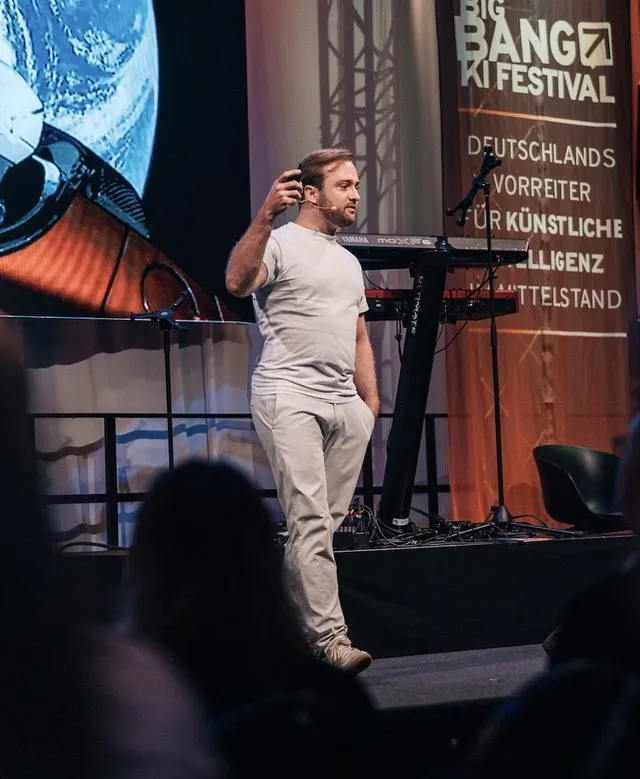
For me, speaking connects with my work as the founder of aiomics: I develop AI for demanding clinical work and share the questions its implementation raises. My medical background helps place consequences for care in context. The entrepreneurial and investor perspectives broaden the discussion to decisions, resources and development. A talk should bring those perspectives together around a question that matters in the room.
This guide helps you write that brief. The formats and examples are planning aids. They promise neither a particular behaviour change after a talk nor recognition as accredited medical education.
The decision behind the event theme
Before choosing a title, complete this sentence: after the event, participants should be better able to judge whether or how to do something specific. “Understand AI” leaves much open. “Distinguish a supplier's claim from evidence for our workflow” describes a concrete capability.
An organiser might write: “Our hospital leaders see many AI demonstrations. Over the coming months, they need to select initiatives. After the talk, they should be able to ask three questions about whether a study transfers to their setting and identify the unresolved responsibility in their own workflow.” This fictional example makes preparation more precise without disclosing confidential cases.
For a pharmaceutical audience, the question might concern distinguishing scientific performance, practical implementation and economic value. For a medium-sized company, it might concern selecting a limited first use. Physicians may be particularly interested in the judgement that remains theirs. The right question follows from your audience; an industry label alone rarely supplies it.
Five details for the first conversation
- Who will be in the room? Include roles, approximate numbers, prior knowledge and the most important forthcoming decision. A mixed group needs shared terms before specialist detail helps.
- What is the specific occasion? Describe the development, uncertainty or decision that makes the event useful. Two or three typical questions are enough initially.
- What should become easier afterwards? Choose a recognisable capability or a decision to prepare. Also identify what the contribution must leave open given the time available.
- What is the event setting? Date, location, language, time including questions, surrounding programme and the person responsible for content preparation belong together.
- Which conditions need early agreement? These include accessibility, potential recording, intended educational accreditation and an already defined budget. The initial enquiry needs no patient records or confidential business documents.
Let the task determine the format
A talk followed by questions can give a larger group a shared foundation. A moderated conversation may suit an event centred on decisions and objections. An exercise needs more: a clearly bounded task, suitable material, an opportunity to work on it and subsequent discussion of the results. A more intensive working format can be agreed with selected partners when the specific task warrants it.
A fictional event plan might allocate 30 minutes to the talk and 15 to questions. Preparation would then favour one central decision, two carefully grounded examples and enough room for questions. This is neither a scientifically optimal duration nor a blanket promise of results. A late slot following several presentations may need a different design from the opening of a small leadership retreat.
A Cochrane review finds generally modest improvements in professional practice from educational meetings in healthcare; it cannot promise an effect from an individual AI talk. [1] For planning, I would therefore distinguish interest in the room from later application. A concrete next step can be agreed after the event; its implementation then belongs to the responsible people.
Scientific questions and medical education
For medical topics, study findings, personal interpretation and proposed applications should remain distinguishable. A model test, a study of collaboration and a patient outcome answer different questions. An accessible example can simplify these levels while preserving the distinctions.
If you are planning recognised continuing medical education in Germany, clarify responsibility and recognition early with the relevant regional medical chamber. Its rules govern recognition. The German Medical Association also addresses scientific leadership, transparency and independence. A topic or talk duration carries no automatic promise of educational credits. [2] [3]
The preparation conversation therefore initially needs to establish whether recognition is sought, who will lead the scientific programme and which documents are required. Content and disclosure of interests must suit the particular event. The audience should be able to recognise a product demonstration and a scientific appraisal for what each is.
Agree accessibility and recording in advance
Ask early about support needs. Clear sound, a microphone for audience questions and materials available in advance can matter greatly. Describing visual information aloud and providing accessible materials makes participation easier. W3C's guidance offers practical orientation. [4]
Recording needs its own agreement. Clarify the intended audience, publication venue, excerpts, editing and period of use. If questions are recorded, that part also needs a suitable arrangement. Preparation should distinguish the materials included in the event from those intended for later public access. This makes expectations concrete before the event day.
A brief both sides can assess
Preparation should end with a short shared description: audience, central question, intended learning, format, available time and outstanding points. A useful check is whether the audience could recognise from this description why this particular contribution belongs in its programme.
If you would like to prepare a talk with me, you can start with the five details above. The organiser page provides the enquiry route; a short biography and approved press photographs are available in the press section. A precise initial brief helps align the subject and setting and makes the connection between building AI and its consequences for your audience visible.
Organiser information and enquiries
Short biography and press photographs
Sources and further reading
- Educational meetings and their effects on professional practice and careCochrane
Systematic review of educational meetings; it does not evaluate an individual AI talk.
- Rules for recognised continuing medical education in GermanyGerman Medical Association
Explains medical chambers’ responsibility for recognition.
- Recommendations on continuing medical education, 20 November 2025 editionGerman Medical Association
Addresses scientific leadership, transparency and independence.
- Making events and presentations accessibleW3C
Practical guidance on accessible events and materials.
Perspective and interests
This guide was developed with AI assistance. The event situations are fictional. Format suggestions and learning goals are planning aids without a promised effect or educational recognition.